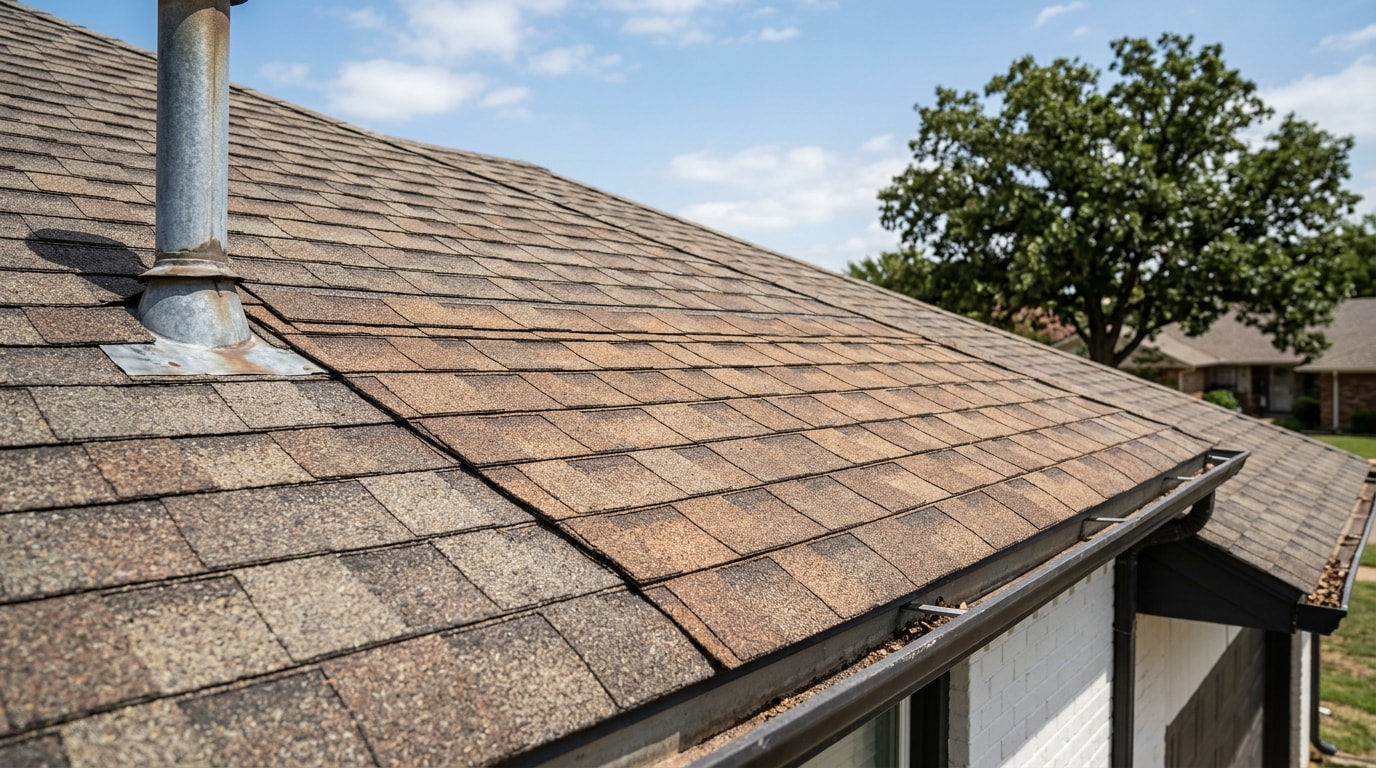
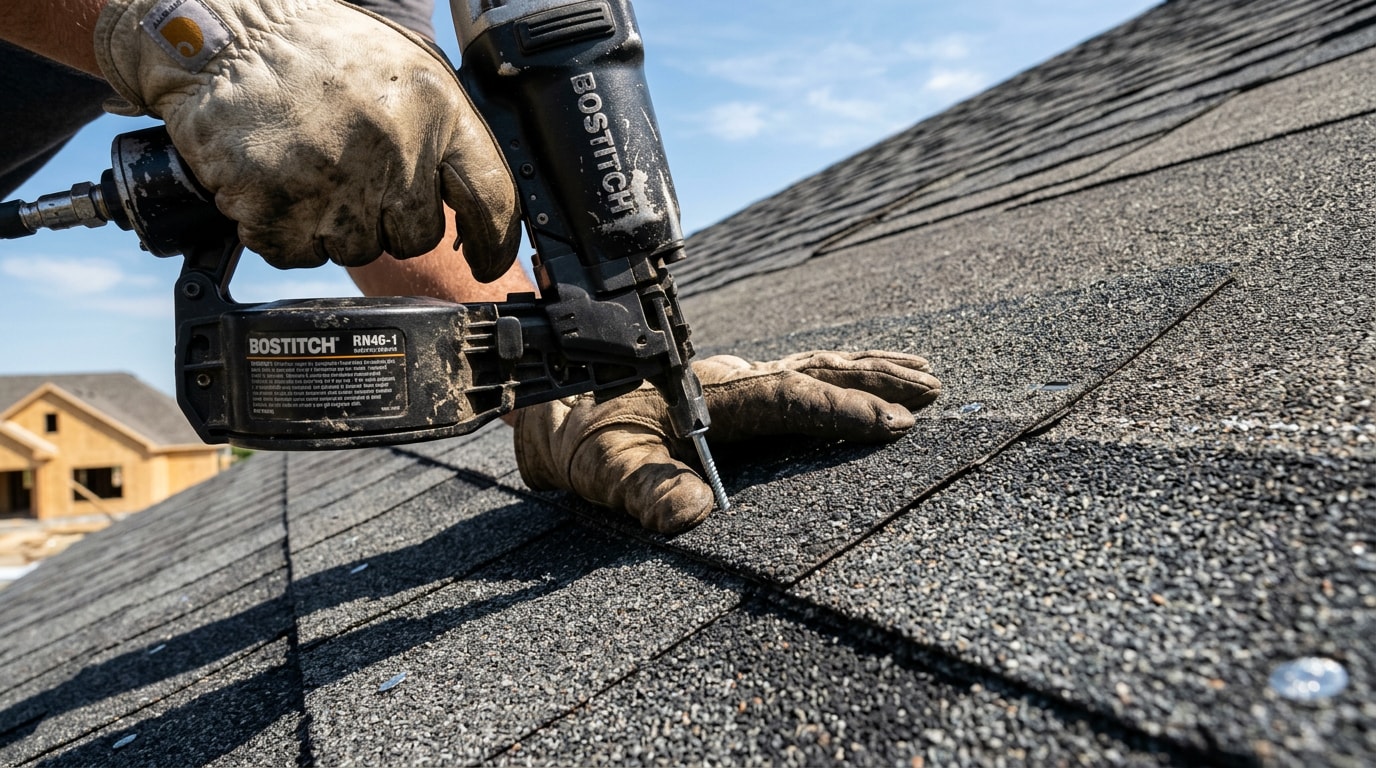
A roofing nail in Oklahoma City, OK has one job: hold a shingle down through hail, 60 mph gusts, and a 100-plus degree swing between July and January. Pick the wrong one and you won't notice for a year or two, right up until a strip of shingles lifts off in a spring storm. Here's what actually holds up in this climate, what code requires, and why so many OKC roofs develop popped nails years after installation.
What Makes a Roofing Nail Different From a Regular Nail
A roofing nail isn't just a smaller construction nail. It's built around three specific features: a wide head, a short, thick shank, and a corrosion-resistant coating.
Those features matter for different reasons:
- The wide head (at least ⅜ inch) spreads load across the shingle so wind uplift doesn't pull the nail straight through the material.
- The short, thick shank gives the nail enough bulk to resist bending or shearing under repeated flexing.
- The corrosion-resistant coating keeps the fastener from rusting out while it sits exposed to decades of Oklahoma humidity and rain.
Swapping in standard framing nails isn't a workable shortcut. They lack the head diameter to hold shingle tabs in wind, and most shingle manufacturers will void a warranty if they find non-roofing fasteners during a claim inspection. The small savings on fasteners rarely survives the first wind claim dispute.
Types of Roofing Nails and Which Materials They Suit
Not every roofing nail performs the same once it's exposed to Oklahoma weather. The four shank types below vary in holding power, cost, and how well they handle a wind-prone roof.

Smooth Shank Nails
Smooth shank nails have a plain, straight shaft with no texture to resist pull-out. They're the cheapest option and widely available, but they offer the weakest holding power of the four types. They're fine for minor patch work, but they're not the right call for a full roof in a wind-prone market like OKC.
Ring Shank Nails
Ring shank nails have raised rings along the shaft that bite into wood fibers instead of just compressing them. One IKO test found that ring shank nails have 300 percent more strength than smooth shank nails. That's the single biggest holding-power jump of any shank style, and it's why ring shank is the standard recommendation for asphalt shingles in storm-exposed regions, which covers essentially the entire OKC metro.
Screw Shank Nails
Screw shank nails have a twisted shaft that threads into the deck like a screw as it's driven, producing the strongest grip of the three nail-shank styles. They cost more than ring shank nails and are typically reserved for heavier materials, such as wood shakes or slate, where the extra holding power earns its price.
Coil Roofing Nails
Coil nails are collated for pneumatic nail guns, which makes them efficient for crews running full tear-offs. Quality varies by manufacturer, though. A poorly made box of coil nails can bend, snap, or underdrive, so it's worth checking the brand before a crew loads a gun with a cheap batch.
Browse our roof installation services to see which fastener pairs with the shingle line you're considering.
What Oklahoma Building Code Requires for Roofing Nails
Code sets firm minimums on gauge, head size, and penetration depth, and those minimums apply the same way whether a home sits in Bricktown or Yukon. Fasteners for asphalt shingles shall be galvanized steel, stainless steel, aluminum or copper roofing nails, with a minimum 12-gauge shank and a minimum ⅜-inch diameter head, complying with ASTM F1667, and of a length to penetrate through the sheathing.
On fastener count, asphalt shingles shall have the minimum number of fasteners required by the manufacturer's approved installation instructions, but not less than four fasteners per strip shingle or two fasteners per individual shingle. That four-nail minimum is the national baseline. Oklahoma's wind exposure pushes many roofs past it.
The Six-Nail Rule for High-Wind Zones
IRC 2018 R905.2.6 requires 4 nails per shingle in standard areas and 6 nails in high-wind zones above 110 mph. That threshold isn't theoretical for Oklahoma City. The city's own adopted building code amendment sets the local design wind speed well into that range: Table R301.2(1) is amended to fill in a wind speed of 115 mph for the jurisdiction. That single number means most new roofs and re-roofs inside city limits should be fastened with six nails per shingle, not four, to meet the intent of the code.
For reference, you can review the full attachment requirements directly on the ICC's published 2021 International Residential Code, Chapter 9.
Choosing the Right Nail Material for Oklahoma's Climate
Oklahoma City isn't coastal, so saltwater corrosion isn't the driving concern here. The combination of hail impact, humidity, and repeated high-wind events puts a different kind of stress on a fastener: it has to keep its grip through constant expansion and contraction, not just resist rust.
| Material | Relative Cost | Best Fit for Oklahoma City |
|---|---|---|
| Galvanized steel | Lowest | Standard choice; zinc coating handles humidity and storm moisture well |
| Stainless steel | Highest | Usually unnecessary here; reserved for coastal or extreme-corrosion jobs |
| Aluminum | Moderate | Common on specialty or metal roofing systems |
| Copper | Moderate to high | Paired mostly with copper flashing or specialty materials |
For most OKC homes, hot-dipped galvanized ring shank nails deliver the right balance of cost and storm resistance without paying for coastal-grade protection the region doesn't need. Galvanized is also what most asphalt shingle manufacturers specify by default, which keeps warranties intact.
If you're also weighing shingle types alongside fasteners, our guide to roofing materials in Oklahoma City breaks down how material choice and fastening work together on a full roof system.
One detail most nail guides skip: Oklahoma's Strengthen Oklahoma Homes program, run by the state insurance department, adopted the FORTIFIED Home – Roof standard, developed after decades of research by the Insurance Institute for Business & Home Safety, as a voluntary beyond-code construction and re-roofing program. Meeting that standard starts at the fastener level: correct nail type, nail count, and penetration depth are baseline requirements for FORTIFIED certification, and a certified evaluator inspects a property and works with the contractor to document that materials and installation methods meet the designation. You can read the program details on the Oklahoma Insurance Department's OKReady site.
Calculating Nail Length, Head Size, and Penetration
The penetration rule matters more than any other sizing detail: a nail must sink at least ¾ inch into solid roof deck to count as compliant and to hold properly. As an example, for ⅜-inch sheathing under a standard architectural shingle, that math typically works out to a nail length of around 1¼ inches.
A few scenarios shift that number:
- Ridge and hip caps add an extra shingle layer, so these areas typically need a longer nail, often 1½ inches, to reach the same ¾-inch deck penetration.
- A re-roof over one existing layer adds roughly another ⅛ to ¼ inch of material, which commonly pushes the needed length to around 1¾ inches.
- Any roof using the six-nail high-wind pattern should pair the extra fasteners with ring shank nails at the correct length. More nails only help if each one is actually seated deep enough.
Head size matters just as much as length. Nails must be corrosion-resistant with a minimum shank diameter of 12 gauge (0.105 inches) and a minimum head diameter of 3/8 inch, and nail length must penetrate the sheathing at least 3/4 inch. A head that's too small lets the nail pull straight through the shingle tab during wind uplift, which is one of the most common storm-damage patterns we see on OKC roofs.
Why Nail Pops Happen More Often in Oklahoma City
Nail pops aren't random. Oklahoma City's wide seasonal temperature swing, generally running from summer highs near 100°F down to winter lows in the teens or lower, puts roof decking through constant expansion and contraction. That cycle repeats every year, and over time it works fasteners loose, especially smooth shank nails that never had much grip to begin with.
Spring storm season adds mechanical stress on top of the thermal cycling. Once a nail starts backing out even slightly, every gust afterward flexes that shingle tab a little further, and the hole around the nail gradually enlarges.
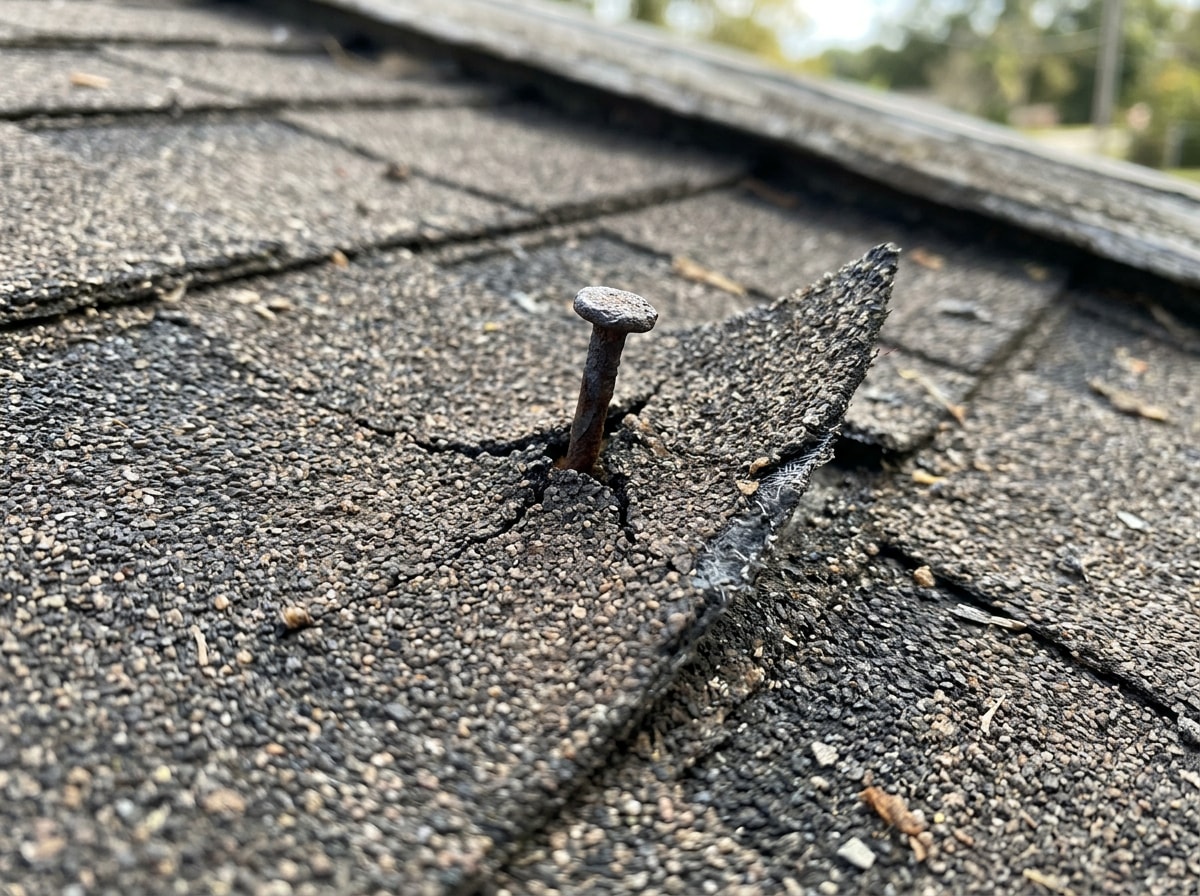
In our repair calls across the metro, the most common root cause isn't nail quality at all. It's installation pressure. A pneumatic nailer set too high drives the nail head through the shingle mat, destroying its grip before the roof is even finished. One set too low leaves the nail sitting proud, where it works loose within a few seasons. Either mistake looks fine on install day and shows up as a raised tab two or three years later.
If you're noticing raised shingle tabs or small bumps across your roof, our roof repair team can assess the extent before it turns into a leak. A quick roof inspection is usually enough to tell whether it's a handful of nails or a sign of a wider installation problem.
How We Fix Popped Roofing Nails
Fixing a popped nail correctly starts with removing the damaged fastener entirely. Tapping it back down just hides the problem for a season.
Once the nail is out, the decking around the hole gets checked for rot or delamination. Oklahoma humidity causes OSB sheathing to swell when moisture gets into an open nail hole, which weakens holding power even before a new nail goes in.
The repair itself follows a short sequence:
- Remove the damaged nail and inspect the exposed decking.
- Repair or sister in new decking material if swelling or rot is present.
- Drive a new ring shank nail about one inch away from the original hole, into solid wood.
- Check the surrounding nails within roughly a three-foot radius, since a nail under enough stress to pop usually isn't the only one affected.
We use ring shank nails for every repair, not smooth shank, because the rings resist backout even as the deck keeps expanding and contracting through the seasons. If your home falls inside our coverage area, see our Oklahoma City service page for response details, or get a free estimate and we'll take a look before small nail pops turn into a bigger repair.
For homeowners planning ahead of storm season, it's worth pairing a nail inspection with a broader check of flashing and ventilation. You can see examples of completed local work on our projects page, and our homepage has an overview of every roofing, gutter, and exterior service we offer across the OKC metro.
FAQ
What type of nail is best for asphalt shingles in Oklahoma City?
A hot-dipped galvanized ring shank nail, roughly 1¼ inches long, in 11- or 12-gauge, is the standard recommendation. It meets code minimums, resists humidity-driven corrosion, and holds significantly better than smooth shank in wind-prone conditions.
How many nails per shingle does Oklahoma City code require?
The baseline is four nails per shingle. Because Oklahoma City's adopted design wind speed sits at 115 mph, which is above the 110 mph threshold that triggers enhanced fastening, most roofs here should use six nails per shingle instead.
What's the difference between roofing nails and regular nails?
Roofing nails have a larger head (at least ⅜ inch), a shorter, thicker shank, and a corrosion-resistant coating. Standard construction nails lack all three, which makes them unsuitable for exterior shingle attachment and likely to void a shingle warranty.
Can I reuse old roofing nails when replacing my roof?
No. Removed nails often have weakened shanks, stripped coatings, or bent tips. Reinstalling them increases the risk of future backout and gives you less corrosion resistance than a fresh nail.
What size nail do I need for a re-roof over an existing layer?
Expect to size up. A re-roof over one existing shingle layer typically needs a nail around 1¾ inches long to still achieve the required ¾-inch penetration into solid deck through the extra material.
Can a framing nail gun install roof shingles?
No. Framing nailers are built for a different fastener diameter and drive depth, and the nails they shoot don't meet the head-size or corrosion-resistance requirements for roofing. Using one risks shingle warranty denial and poor wind performance.